Obsidian Crystal Meaning: Types, History, Placement and Care

Key takeaways
- Obsidian crystal is the everyday name for obsidian, but geologists call it a volcanic glass, not a true crystal, because it forms too fast for crystals to grow.
- Popular types include black, snowflake, rainbow, gold sheen, mahogany obsidian and Apache tears; each look comes from inclusions or trace elements.
- People have used obsidian for tools and mirrors for thousands of years, from ancient blades to the Aztec mirror later owned by John Dee.
- In crystal and feng shui traditions, obsidian is linked with protection and grounding; these are cultural meanings, not proven effects.
- At about 5 to 5.5 on the Mohs scale, it scratches and chips easily, so store it apart and clean it with mild soap and water.
The obsidian crystal meaning in most traditions is protection, grounding and seeing the truth, a symbolism inspired by its glossy black, mirror-like surface. Strictly speaking, though, obsidian is not a crystal at all. According to Geology.com, it forms when molten rock cools so quickly that atoms cannot arrange into crystals.
This guide covers both sides. First, you will learn how obsidian forms and how to tell the main types apart. Then we explore its long history, its meaning in crystal and feng shui culture, and practical tips for wearing, placing and caring for it.
Table of contents
What is an obsidian crystal, really?
Obsidian is natural volcanic glass. When lava rich in silica cools very fast, often at the edge of a flow or where it meets water, there is no time for crystals to grow. As a result, the material stays glassy and smooth.
Geology.com calls it a mineraloid, meaning a natural solid without a crystal structure. Similarly, the American Museum of Natural History describes it as glass formed from rapidly cooled lava. So why do shops say "obsidian crystal"? Simply put, the term comes from the crystal-collecting world, where it is used loosely for any polished stone.
| Property | Obsidian | What it means for you |
|---|---|---|
| Type | Volcanic glass (mineraloid) | Not a true crystal; no facets form naturally |
| Main component | Silica, about 70% or more | Same family as rhyolite lava |
| Hardness | About 5 to 5.5 Mohs | Scratches more easily than quartz |
| Fracture | Conchoidal (shell-shaped) | Breaks into very sharp edges |
| Luster | Glassy | Takes a mirror-like polish |
Because it is a glass, obsidian also changes slowly over time. Geology.com explains that it gradually crystallizes, starting at scattered points. Therefore, very old obsidian is rare; most deposits are geologically young.

Types of obsidian crystal and how to tell them apart
Although most obsidian is black, small inclusions and trace elements create several popular varieties. Here are the six you will see most often.
| Type | Look | Why it looks that way |
|---|---|---|
| Black obsidian | Solid, glossy black | Tiny mineral particles darken the glass |
| Snowflake obsidian | Black with white or gray "flowers" | Clusters of cristobalite crystals form as the glass ages |
| Rainbow obsidian | Bands of color under light | Light reflects off tiny inclusions |
| Gold or silver sheen | A metallic shimmer | Inclusions of crystals or gas bubbles |
| Mahogany obsidian | Black swirled with red-brown | Iron-rich colors mixed into the glass |
| Apache tears | Small, rounded nodules | Natural lumps from the southwestern United States |
Snowflake obsidian
Interestingly, the white spots are early crystals growing inside the glass. In other words, snowflake obsidian is obsidian caught in the act of slowly turning crystalline.
Rainbow and gold sheen obsidian
However, these show their color only in direct light. To see the effect, turn the stone slowly under a lamp. In contrast, in dim light they look like plain black obsidian crystal.
Apache tears
According to Geology.com, these small nodules are about an inch or less. Their name comes from a legend about Apache warriors in an 1870 battle, and many people treat them as stones of comfort.
A short history of obsidian crystal
Long before it was a "crystal," obsidian was a tool. Because it breaks into extremely sharp edges, ancient people across the world shaped it into knives, arrowheads and scrapers. The USGS Yellowstone Volcano Observatory notes that obsidian from Yellowstone was traded far across North America. Likewise, USGS Volcano Watch describes how scarce and prized it was in Hawaii.
Mirrors and the Aztec "smoking mirror"
In addition, polished obsidian made some of the world's earliest mirrors. In Aztec belief, the god Tezcatlipoca, whose name means "smoking mirror," was linked with obsidian. Perhaps the most famous example is the black mirror later owned by John Dee, adviser to Queen Elizabeth I. As Archaeology magazine reports, its chemical signature matches obsidian from Pachuca, Mexico.
Today, that mirror is in the British Museum. Live Science adds that notes stored with it call it "The Devil's Looking-glass." This story helps explain why obsidian crystal is still tied to ideas of reflection and seeing what is hidden.

Obsidian crystal meaning in crystal and feng shui culture
In modern crystal traditions, obsidian has a fairly consistent set of meanings. However, these are cultural beliefs, not scientific findings, and they should never replace medical or professional care.
- Protection: its dark, reflective surface is seen as a shield against negativity.
- Grounding: as a stone born from the earth's fire, it symbolizes stability.
- Truth and self-reflection: inspired by obsidian mirrors, it represents honest insight.
- Letting go: many people use it as a reminder to release old habits.
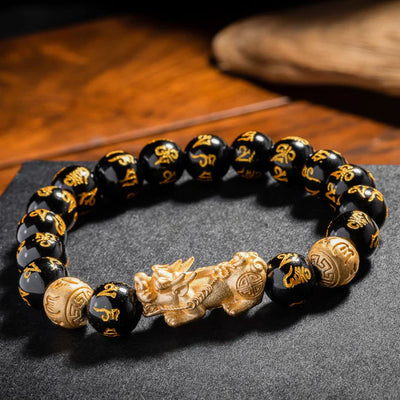
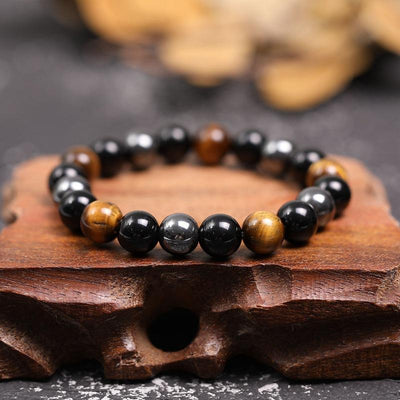
In addition, each type carries its own nuance. For example, snowflake obsidian is often linked with balance, rainbow obsidian with hope, and gold sheen obsidian with prosperity. Meanwhile, black obsidian is one of the most popular stones for Pixiu bracelets in Chinese feng shui jewelry.
For a deeper look at one popular form, read our guide to the black obsidian bracelet meaning.
Feng shui placement for an obsidian crystal at home
In feng shui, the color black belongs to the water element. As a result, an obsidian crystal is often placed where people want calm, protective energy. Here are common placements and the ideas behind them.
| Placement | Traditional idea | Practical tip |
|---|---|---|
| Near the front door | Guarding the entrance | Keep it on a stable shelf, away from foot traffic |
| On a work desk | Focus and clear boundaries | A small sphere or tower takes little space |
| North area of the home | Water element, career area | Pair with a clean, uncluttered space |
| Living room corner | Grounding a busy room | Use a cluster or a carved piece as decor |
| Beside electronics | A popular modern custom | Treat it as decor; it does not block signals |
Size matters too. In general, a small sphere suits a desk, while a larger carving works as a focal point in a living room. Also, consider pairing obsidian with a living plant, since the plant adds the wood element and softens the dark color. As a result, the corner feels balanced rather than heavy.
Many feng shui teachers advise against keeping large black stones right beside the bed, because their energy is considered strong. Instead, they suggest a lighter stone in the bedroom. Ultimately, choose a spot that feels calm to you and is safe from knocks.

How to wear obsidian crystal: both wrist customs
There is no single rule for which wrist to wear obsidian on. Instead, two customs are common, and both are part of living tradition.
- Left wrist: many crystal practitioners say the left hand "receives," so they wear obsidian there to take in protective energy.
- Right wrist: others, especially in some feng shui and Pixiu traditions, say the right hand "acts" or "releases," so they wear it there.
So which is correct? Both are valid within their own traditions. In practice, pick the side that feels right, or the side that is comfortable for daily life. For example, many people avoid the wrist they write with, simply to protect the beads.
Also, obsidian is a fairly soft stone. Geology.com notes that it lacks toughness and chips on impact, so pendants and earrings are often safer than rings. If you choose a bracelet, take it off for sports, cooking and heavy work. For sizing, see our bracelet size chart, and for Pixiu styles read how to wear a pixiu bracelet.
Obsidian crystal vs other black stones
Shoppers often confuse obsidian with other dark stones. Although they look alike in photos, they differ in hardness, weight and feel. Here is a quick comparison to help you choose.
| Stone | What it is | Relative hardness | How to recognize it |
|---|---|---|---|
| Obsidian | Volcanic glass | Softer (about 5 to 5.5) | Glassy luster, shell-shaped chips |
| Black onyx | A banded chalcedony (quartz family) | Harder | Even, waxy-to-glassy polish |
| Black tourmaline | A crystalline mineral | Harder | Striated, column-shaped crystals |
| Hematite | An iron oxide mineral | Similar to slightly harder | Metallic shine, heavy weight |
| Jet | Fossilized wood | Much softer | Very light, feels warm to the touch |
In short, obsidian is the glassiest of the group. By contrast, onyx and black tourmaline are harder, so they suit everyday rings and bracelets a little better. Meanwhile, hematite feels noticeably heavy in the hand, which makes it easy to spot.
Which black stone should you choose?
If you love the mirror-like shine and the volcanic story, choose obsidian crystal. On the other hand, if you want a tougher stone for daily wear, a harder option may last longer. Either way, many people enjoy combining them, for example an obsidian pendant with a tourmaline bracelet.
Getting started with obsidian crystal
If you are new to obsidian, start small. For instance, a palm stone or a single pendant lets you get to know the material before you buy more. Then you can decide which type you enjoy most.
- Start with one piece. First, choose the type whose look you like best.
- Give it a place. Next, keep it where you will see it daily, such as your desk.
- Set an intention. Also, decide what it reminds you of, such as calm or honesty.
- Look after it. Finally, store it gently and clean it now and then.
Because obsidian chips easily, beginners often prefer smooth shapes over sharp points. Similarly, a tumbled stone is less fragile than a thin carving. Above all, enjoy it as a piece of earth history with a rich cultural story.
How to buy a real obsidian crystal
Because obsidian is natural glass, man-made glass can look very similar. For this reason, buy from sellers who name the material clearly. Here are a few checks that help.
- Look for small flaws. Natural obsidian often has tiny bubbles, bands or inclusions.
- Check the edges. Chips should show a shell-shaped, conchoidal break.
- Be wary of bright colors. Natural obsidian is mostly black, brown or gray; vivid blue or green "obsidian" is usually glass.
- Read the listing. Next, look for the stone type, bead size and cord material.
- Ask questions. Finally, a good seller will answer clearly about origin and care.
It also helps to ask about treatments. Some "obsidian" is dyed or coated to boost color, and a coating can wear off. For that reason, a clear listing that names any treatment is a good sign of an honest seller.
The International Gem Society notes that obsidian is widely available and generally affordable. Therefore, a very high price is not a sign of quality on its own.
Obsidian crystal care and storage
In general, obsidian is easy to clean but easy to scratch. The International Gem Society care guide recommends gentle methods for most gems: warm water, mild detergent and a soft brush. Then dry each piece well.
- First, store your obsidian crystal in a soft pouch, apart from harder stones like quartz.
- Also, avoid dropping it on hard floors, since it chips easily.
- Skip ultrasonic cleaners for carved or glued pieces.
- Then check bracelet cords regularly and restring when they fray.
Many owners also refresh their pieces with a ritual such as incense or moonlight. Our guide on how to cleanse feng shui items explains safe methods by material.

Overall, an obsidian crystal is a striking piece of natural history. As LibreTexts Geology and Amethyst Galleries both describe, it is a glass made by volcanoes. With that in mind, you can enjoy its meaning, its beauty and its story with honest expectations.
Find your obsidian piece
Browse our obsidian collection, including the Rainbow Obsidian Necklace and the Obsidian Mani Mantra Bracelet. Each listing names the stone type, size and materials.
Key Terms Explained
- Mineraloid: A natural solid, like obsidian, that lacks a crystal structure.
- Conchoidal fracture: A smooth, shell-shaped break typical of glass and obsidian.
- Cristobalite: A form of silica whose crystals create the "snowflakes" in snowflake obsidian.
- Sheen: A shimmer caused by light reflecting off tiny inclusions.
- Tezcatlipoca: An Aztec god whose name means "smoking mirror."
Frequently Asked Questions
Is obsidian a real crystal?
No. Obsidian is volcanic glass, a mineraloid with no crystal structure. "Obsidian crystal" is a popular name used in the crystal and jewelry world.
What is obsidian crystal good for?
In crystal and feng shui traditions it symbolizes protection, grounding and self-reflection. These are cultural meanings, not proven effects, and it is not a substitute for medical care.
Which wrist should I wear an obsidian crystal on?
Both customs exist. Many crystal practitioners choose the left wrist to "receive," while some feng shui traditions choose the right. Pick the side that suits you.
Can obsidian crystal get wet?
Yes, it tolerates warm water and mild soap. Dry it well, and keep cords and glued parts out of long soaks.
How can I tell if obsidian is real?
Look for natural flaws, a shell-shaped break on chips and natural colors such as black, brown or gray. Very bright colors usually mean man-made glass.
References
- Geology.com – Obsidian
- Wikipedia – Obsidian
- American Museum of Natural History – Obsidian
- USGS – Yellowstone's tool-making lava flows
- International Gem Society – Obsidian jewelry and gemstone information
- USGS Volcano Watch – Obsidian, a scarce commodity in Hawaii
- Wikipedia – Tezcatlipoca
- Archaeology magazine – Reflecting the past
- Live Science – John Dee's spirit mirror came from the Aztec Empire
- Wikipedia – Feng shui
- International Gem Society – Gemstone care guide
- LibreTexts Geology – Obsidian
- Amethyst Galleries – Obsidian
Meanings described here are cultural traditions and personal symbolism. Jewelry is not a substitute for medical, financial or professional advice, and no result is guaranteed.
Which bracelet is right for you? Picks from this guide


Sample Image Gallery