Black Obsidian Bracelet: Meaning, Which Wrist and How to Spot Fakes

Key takeaways
- A black obsidian bracelet is made of natural volcanic glass, not a crystal. It forms when silica-rich lava cools too fast for crystals to grow.
- In feng shui and crystal tradition, black obsidian is worn as a protective, grounding stone. These meanings are cultural beliefs, not guarantees.
- Obsidian is softer than quartz, at about 5 to 5.5 on the Mohs scale, so it scratches and chips more easily.
- Many people wear a protective black obsidian bracelet on the left wrist, often paired with a Pixiu charm for wealth.
- Real obsidian feels cool, shows a glassy shine and may have tiny bands or bubbles. Perfect, bubble-free black beads can be glass.
A black obsidian bracelet is a string of beads cut from natural volcanic glass, and it is one of the most popular protection bracelets in feng shui jewelry. It looks like polished black glass because that is what it is. According to the U.S. Geological Survey (USGS), obsidian is dense volcanic glass that cools from molten lava so quickly that crystals cannot form.
This guide explains the black obsidian bracelet from both sides. First, you will learn the geology in plain words. Next, you will see the meaning it holds in Chinese and crystal traditions. Finally, you get practical tips on which wrist to use, how to spot fakes and how to keep the beads shiny for years.
Table of contents
- What is a black obsidian bracelet?
- How obsidian forms
- Types of obsidian beads
- Meaning in feng shui and crystal tradition
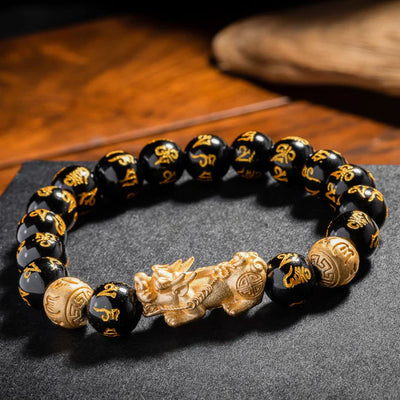
- Black obsidian bracelet with Pixiu
- Which wrist to wear it on
- How to tell real obsidian
- Obsidian compared with other dark stones
- Hardness and durability
- Care and cleansing
- How to choose your bracelet
- Frequently Asked Questions
- References
What is a black obsidian bracelet?
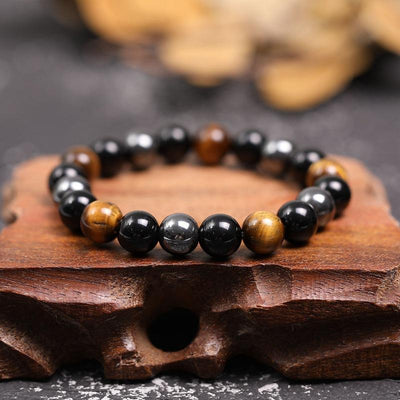
A black obsidian bracelet is usually a ring of round, polished obsidian beads on elastic cord. Some designs add a carved charm, such as a Pixiu, a Buddha or a six-syllable mantra bead. Others mix obsidian with tiger's eye or hematite.
However, obsidian is not a mineral in the strict sense. It is a natural glass, so it has no crystal structure. The American Museum of Natural History calls it a rare, crystal-poor form of rhyolite, the most silica-rich lava. In other words, your bracelet is a piece of a volcano that cooled in an instant.
That origin explains its look. Because there are no crystals, the surface takes a mirror-like polish. As a result, light reflects in a smooth, glassy way. Many people say good obsidian beads look almost liquid in daylight.

How obsidian forms
To understand your beads, it helps to know how the stone forms. Obsidian needs a special kind of lava. According to the USGS, it erupts from very viscous magma that is high in silica and very low in water. When this thick lava cools fast, crystals have no time to grow.
The Yellowstone Volcano Observatory adds a number. It says obsidian forms from rhyolite magma that is typically more than 74% silica by weight. For example, Obsidian Cliff in Yellowstone erupted around 106,000 years ago. People have used obsidian from that flow for at least 11,000 years.
Why the stone is black
Obsidian looks black, yet it contains no black pigment. Instead, the USGS explains that tiny crystals of iron oxide give the glass its dark color. Different forms of iron can also tint obsidian red, brown or green. Also, high viscosity keeps impurities from mixing, so obsidian is often banded or streaked.
Why obsidian is relatively young
Interestingly, obsidian does not last forever on a geologic scale. The USGS notes that most obsidian is younger than 20 million years. Over time, the glass slowly turns into crystalline rock, a process called devitrification. So every obsidian bead comes from a fairly young volcanic flow.
Types of obsidian beads
Black is the classic choice, but obsidian comes in several looks. According to LibreTexts Geosciences, obsidian can be black, gray, brown or green, and inclusions can create a gold or silver sheen. Here are the types you will see most in bracelets.
| Type | Look | Common use |
|---|---|---|
| Black obsidian | Deep, even black with a glassy shine | Classic protection bracelet and Pixiu designs |
| Rainbow obsidian | Black in shade, bands of color in light | Gentle, colorful everyday bracelet |
| Gold sheen obsidian | Golden shimmer across black beads | Wealth-themed Pixiu bracelets |
| Snowflake obsidian | Black with gray-white spots | Casual bead bracelets |
| Mahogany obsidian | Black with red-brown streaks | Earthy, warm-toned designs |
In practice, plain black beads suit almost any outfit. Meanwhile, rainbow and gold sheen beads only show their color when light hits them at an angle. So check photos taken in daylight before you buy.

Black obsidian bracelet meaning in feng shui and crystal tradition
Across many cultures, black obsidian has a protective image. In Chinese feng shui jewelry, a black obsidian bracelet is often worn to keep away negative influences and to feel grounded. In Western crystal tradition, it is called a "shield" stone.
Still, these are symbolic meanings. A black obsidian bracelet cannot block harm, cure illness or guarantee money. Instead, think of it as a daily reminder of an intention, such as staying calm, setting boundaries or protecting your energy at work.
- Protection: the most common reason people choose black obsidian.
- Grounding: the heavy, dark stone feels steady on the wrist.
- Clarity: some people use its mirror-like shine as a cue for honest self-reflection.
- Wealth (with Pixiu): when paired with a Pixiu, the bracelet also carries a wealth meaning.
Where the protective idea comes from
Historically, obsidian was valuable because it made sharp tools. The USGS notes that its conchoidal fracture leaves edges sharper than the finest steel blades. Native Americans prized it for arrowheads and traded it hundreds of miles. Therefore, it is easy to see how a stone used for blades became a symbol of defense.
Black obsidian bracelet with Pixiu
Perhaps the best-known feng shui design pairs black obsidian beads with a Pixiu charm. The Pixiu is a mythical Chinese beast said to attract wealth and never let it escape. In this design, obsidian adds protection while the Pixiu adds a wealth wish.
Traditionally, the Pixiu faces outward, toward your fingers, so it can "catch" good fortune. Many wearers also avoid letting others touch their Pixiu. These are customs rather than rules, so follow the ones that feel meaningful to you.
For a full guide to the charm itself, read our Pixiu bracelet meaning guide.

Which wrist to wear a black obsidian bracelet on
Feng shui and crystal traditions give simple guidance. For example, many people wear a protective black obsidian bracelet on the left wrist. In this view, the left hand "receives" and the right hand "gives". So a protective or wealth stone goes on the left to keep good energy in.
However, practice differs between teachers. Some people simply wear the bracelet on the hand they use less, to protect the beads from knocks. That is sensible, because obsidian chips more easily than quartz.
- Set an intention. Decide what the bracelet reminds you of, such as calm or focus.
- Choose a wrist. The left wrist is the most common choice for protection.
- Check the fit. Measure your wrist and add about 1–2 cm so beads do not pinch.
- Face the Pixiu outward. If your design has a Pixiu, point its head toward your fingers.
- Give it a rest. Take it off for sleep, sports and cleaning to avoid chips.
Our guide to the feng shui principles of wearing bracelets covers more of these customs.
How to tell a real black obsidian bracelet
Because obsidian is natural glass, man-made glass can look very similar. Still, a few checks help. None of them is perfect, so buy from a seller who names the material clearly.
- Temperature: real obsidian feels cool when you first touch it, then warms slowly.
- Tiny flaws: natural beads may show faint bands, streaks or very small bubbles under a loupe.
- Sheen: rainbow and gold sheen appear only at certain angles; painted coatings look the same from every angle.
- Weight: obsidian is a little lighter than quartz of the same size, but heavier than plastic.
- Price: obsidian is common and affordable, so a very cheap "rare" obsidian is a warning sign.
Also, the Amethyst Galleries mineral guide notes that obsidian is much softer than quartz. So do not try a scratch test on a bead you plan to keep. A scratch will damage real obsidian too.
Black obsidian bracelet compared with other dark stones
Shoppers often compare a black obsidian bracelet with onyx, black tourmaline and hematite. They look similar from a distance. However, they differ in material, hardness and feel.
| Stone | What it is | Mohs hardness | Look and feel |
|---|---|---|---|
| Black obsidian | Natural volcanic glass | About 5–5.5 | Glassy, mirror-like shine; light |
| Black onyx | Banded chalcedony (quartz family) | About 6.5–7 | Even, waxy black; tough |
| Black tourmaline | Boron silicate crystal | About 7–7.5 | Matte to glossy, often striated |
| Hematite | Iron oxide | About 5.5–6.5 | Metallic silver-black; heavy |
In short, choose a black obsidian bracelet for its glassy depth and protective meaning. However, choose onyx or tourmaline if you need a tougher bead for daily knocks. Our obsidian jewelry collection lists the material of every piece.
Hardness and durability
Hardness is where a black obsidian bracelet needs a little care. On the Mohs scale, obsidian sits at about 5 to 5.5. By comparison, the USGS gemstone guide lists feldspar at 6 and quartz at 7. That means quartz dust, sand and harder stones can scratch obsidian.
Moreover, glass breaks differently from crystals. The International Gem Society describes obsidian as brittle and heat-sensitive. A hard knock on a stone counter can chip a bead. Also, sudden heat, such as a hot car dashboard, is best avoided.
Fortunately, beads on elastic cord are fairly safe, because they move when they hit something. Most chips happen at the edges of carved charms. So handle Pixiu and Buddha pendants with extra care.
How long does a black obsidian bracelet last?
With sensible care, obsidian beads can last for many years. Usually, the cord wears out first. Check the elastic every few months and restring it if it looks thin or loose.
Care and cleansing
Good care keeps your black obsidian bracelet glossy. The steps are simple.
- Wipe the beads with a soft, dry cloth after wearing.
- For deeper cleaning, use lukewarm water with a drop of mild soap, then dry at once.
- Avoid ultrasonic cleaners, steam and harsh chemicals.
- Store it apart from quartz, diamonds and other harder stones.
- Remove it for the gym, swimming, gardening and housework.
In crystal tradition, people also "cleanse" protective stones from time to time. Common methods include moonlight, sound from a singing bowl or a few minutes of smoke from sage or incense. These are rituals, not cleaning methods, and they are safe for obsidian as long as you avoid heat and water soaking. For more ideas, see our guide on how to cleanse feng shui items.

Is black obsidian good for beginners?
Yes, it is a friendly first stone. It is affordable, easy to find and simple to style. Also, plain black beads go with work clothes and casual outfits alike. If you are new to feng shui jewelry, start with one simple strand. Then, after a few weeks, notice whether it helps you remember your intention. If it does, you can add a second bracelet with a different meaning, such as citrine for prosperity or rose quartz for kindness.
How to choose your black obsidian bracelet
Now you know what the stone is and how to care for it. Next, use these points to pick one you will enjoy wearing.
- Bead size: 8 mm beads look classic; 10–12 mm beads look bold on larger wrists.
- Design: plain beads for a minimal look, or a Pixiu, Buddha or mantra charm for added meaning.
- Mix: tiger's eye adds warmth, hematite adds shine, and cinnabar adds a red accent.
- Size: measure your wrist and add about 1–2 cm; see our bracelet size chart.
- Honest listing: look for clear material names and daylight photos.
Finally, remember that meaning is personal. Any bracelet works best as a reminder you actually wear. So choose the style you like to look at every day. For a broader view, read our guide on how to choose a feng shui bracelet and our obsidian crystal guide.
Find your black obsidian bracelet
Browse the Black Obsidian Pixiu Bracelet, the Natural Rainbow Obsidian Bracelet and our full obsidian collection. Every listing names the material, and you can ask us about any stone before you buy.
Key Terms Explained
- Obsidian: Natural volcanic glass that forms when silica-rich lava cools too fast for crystals to grow.
- Rhyolite: A silica-rich volcanic rock; obsidian has a rhyolite-like chemistry.
- Conchoidal fracture: A smooth, curved break typical of glass, which leaves very sharp edges.
- Devitrification: The slow change of natural glass into crystalline rock over geologic time.
- Pixiu: A mythical Chinese beast linked with attracting and keeping wealth.
Frequently Asked Questions
What does a black obsidian bracelet mean?
In feng shui and crystal tradition, a black obsidian bracelet stands for protection and grounding. It is a symbolic reminder of an intention, not a guarantee of any result.
Which hand should I wear a black obsidian bracelet on?
Many people wear it on the left wrist, the receiving hand in feng shui tradition. Others choose the hand they use less to protect the beads from knocks.
Can I wear a black obsidian bracelet every day?
Yes. Take it off for sleep, sports and cleaning, and store it apart from harder stones, because obsidian scratches and chips more easily than quartz.
How can I tell if my black obsidian bracelet is real?
Real obsidian feels cool, has a glassy shine and may show faint bands or tiny bubbles. Perfect, flawless black beads at a very low price may be glass.
Can a black obsidian bracelet get wet?
A quick rinse is fine, but avoid long soaking, hot water and chemicals, which can weaken the elastic cord and dull the polish.
References
- USGS – Volcano Watch: Obsidian, a scarce commodity in Hawaii
- USGS Yellowstone Volcano Observatory – Yellowstone's tool-making lava flows
- American Museum of Natural History – Obsidian
- Geology.com – Obsidian: igneous rock, uses and properties
- LibreTexts Geosciences – Obsidian (gemology)
- International Gem Society – Obsidian jewelry and gemstone information
- Amethyst Galleries – Obsidian mineral data
- USGS – Gemstones: mineral hardness and the Mohs scale
- USGS – Volcanic glass (obsidian) specimen image
- Wikipedia – Feng shui
- Wikipedia – Pixiu
Meanings described here are cultural traditions and personal symbolism. Jewelry is not a substitute for medical, financial or professional advice, and no result is guaranteed.
Which bracelet is right for you? Picks from this guide


Sample Image Gallery